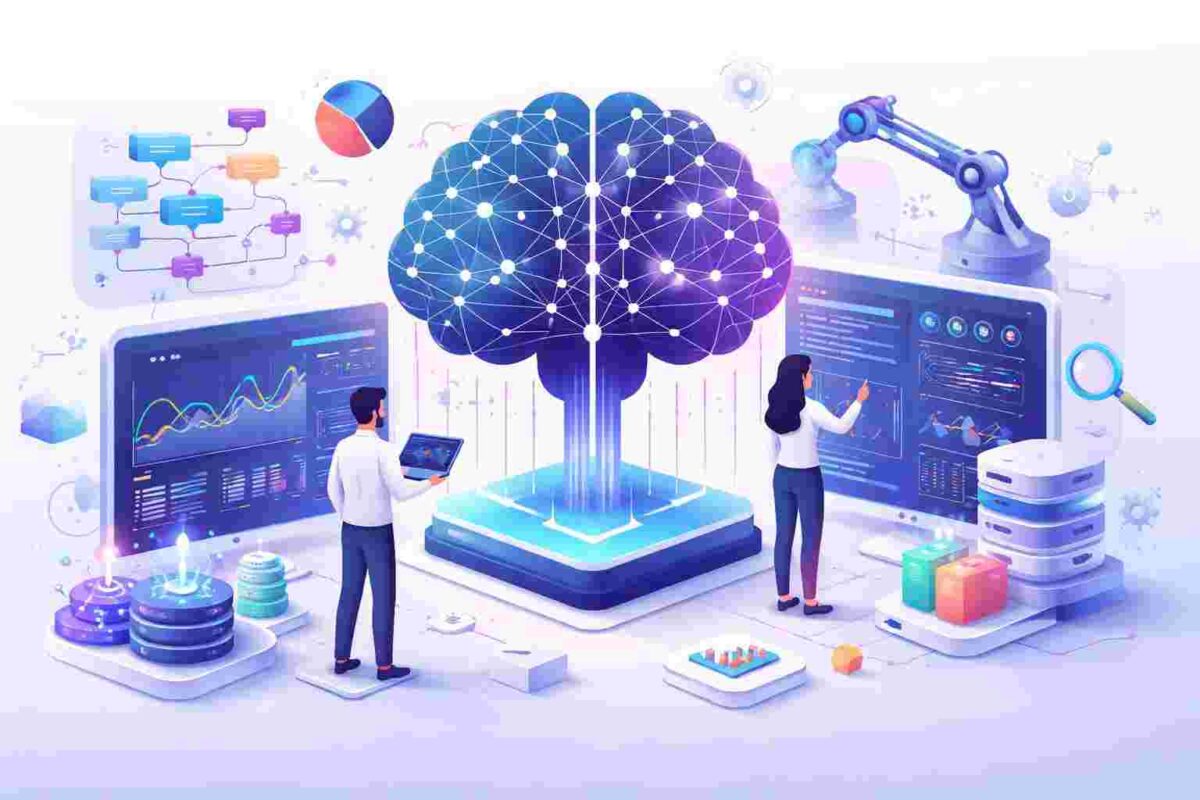
Machine learning basics is a paradigm that has transformed how we interact with technology and make decisions. As a crucial component of artificial intelligence (AI), machine learning enables systems to learn from data, improving their performance over time without explicit programming. In today’s data-driven world, understanding machine learning is essential for professionals across various sectors, from healthcare to finance.
Introduction to Machine Learning
To grasp the fundamentals of machine learning, we must first delve into its definition, historical background, and the types that exist.
Definition of Machine Learning
Machine learning refers to the study of algorithms and statistical models that enable systems to perform tasks without explicit instructions. Instead, they use patterns and inference from data. This allows machines to adapt to new inputs and generate outputs based on previous experiences.
History and Evolution
The roots of machine learning trace back to the mid-20th century, with the establishment of the first neural network by Frank Rosenblatt in 1958. Progress continued through the decades, leading to significant milestones such as IBM’s Deep Blue defeating chess champion Garry Kasparov in 1997 and Google’s AlphaGo beating Go champion Lee Sedol in 2016. These events underscored machine learning’s capabilities, marking it as a major milestone in AI development.
Types of Machine Learning
- Supervised Learning: Involves training a model on labeled data, where the desired output is known.
- Unsupervised Learning: No labeled data is used; the model tries to find patterns and relationships within the data.
- Reinforcement Learning: Machines learn to make decisions through trial and error, receiving rewards or penalties.
- Semi-Supervised Learning: A combination of labeled and unlabeled data to improve learning accuracy.
- Deep Learning: A subset of machine learning that uses neural networks with many layers to analyze various types of data.
Core Mechanisms of Machine Learning
Understanding the core mechanisms behind machine learning is crucial for appreciating how these systems operate effectively.
Supervised vs. Unsupervised Learning
Supervised learning is typically used for classification and regression problems. An example is predicting house prices based on various features (supervised). Conversely, unsupervised learning detects hidden patterns without supervision, such as clustering customers based on purchasing behavior.
Neural Networks Basics
Neural networks mimic human brain function and consist of interconnected nodes (neurons) that process input data. Layered architecture—input, hidden, and output layers—allows for complex representation of data, enabling deep learning models to achieve high accuracy in tasks such as image recognition and natural language processing.
Training and Testing Models
Training involves adjusting model parameters using historical data to minimize errors, while testing evaluates the model’s performance on unseen data. This split between training and testing data is vital to ensure that the model can generalize well, avoiding the pitfalls of overfitting.
- Collect Data: Essential for training models.
- Preprocess Data: Clean and format data to enhance quality.
- Choose Algorithm: Select suitable algorithms based on the problem.
- Evaluate Model: Use metrics such as accuracy or F1-score to measure efficacy.
- Tune Hyperparameters: Further refine the model by optimizing parameters.
Machine Learning in Industry: A Business Overview
The impact of machine learning spans numerous industries, infusing efficiency and intelligence into core processes.
Healthcare Applications
In healthcare, machine learning is revolutionizing patient care. From predictive analytics helping identify at-risk patients to image analysis in radiology, machine learning allows for personalization in treatment plans. For example, IBM Watson uses machine learning to assist in diagnosing diseases and recommending targeted treatments.
Finance and Risk Assessment
Machine learning in finance is primarily used for fraud detection, risk assessment, and algorithmic trading. By analyzing transaction patterns, financial institutions can flag abnormalities that suggest fraudulent activity. AI-powered engines also assess credit risk by examining a borrower’s background and payment history, automating and enhancing traditional processes.
Retail and Customer Insights
Retailers utilize machine learning to personalize customer experiences, optimizing product recommendations based on browsing habits. For instance, Amazon’s recommendation system employs machine learning algorithms to suggest products, driving significant sales growth.
- Predictive Analytics: Anticipating trends based on historical data.
- Inventory Management: Optimizing stock levels through demand forecasting.
- Pricing Strategy: Adjusting prices dynamically based on market conditions.
- Customer Segmentation: Grouping customers for tailored marketing efforts.
- Supply Chain Optimization: Enhancing logistics with data-driven insights.
Strategic Advantages of Machine Learning Adoption
Implementing machine learning can deliver significant competitive advantages in a rapidly evolving market landscape.
Operational Efficiency
Machine learning automates repetitive tasks, freeing up human resources to focus on strategic initiatives. Workflow automation in customer service, like chatbots, significantly reduces operational costs while improving response times.
Enhanced Customer Experience
Businesses leveraging machine learning can better understand customer preferences, behaviors, and needs. This insight enables personalized marketing strategies that improve engagement and satisfaction, ultimately leading to higher retention rates and increased sales.
Data-Driven Decision Making
Data-driven organizations thrive by leveraging insights derived from data analytics. Machine learning provides actionable insights that inform strategic decisions, enabling businesses to pivot swiftly in response to market demands, thereby fostering a culture of continuous improvement.
- Competitive Benchmarking: Understanding market standing against key players.
- Risk Management: Proactively identifying and mitigating risks.
- Performance Measurement: Utilizing metrics to evaluate operational success.
- Innovation Driver: Encouraging new product development through insights.
- Long-term Growth: Establishing a sustainable business model through adaptability.
Limitations and Risks in Machine Learning
Despite its advantages, machine learning comes with its own set of challenges and risks that must be acknowledged.
Bias in Algorithms
One significant risk is the potential for bias in algorithms, often stemming from biased training data. This can result in discriminatory practices in decision-making processes, necessitating careful examination and bias mitigation strategies.
Data Privacy Issues
As machine learning systems often rely on large datasets, data privacy becomes a critical concern. Organizations must comply with regulations like GDPR and ensure that sensitive information is protected, minimizing the risk of data breaches.
Overfitting and Generalization
Overfitting occurs when a model is too complex, capturing noise instead of the underlying pattern in the data. This leads to poor performance on unseen data, highlighting the importance of balancing model complexity with generalization capability.
- Resource Intensive: Requires significant computational resources.
- Transparency Issues: Difficulty in interpreting complex models.
- Dependency on Data Quality: Poor data quality leads to unreliable outputs.
- Workforce Impact: Potential job displacement in certain sectors.
- Regulatory Challenges: Navigating evolving compliance landscapes.
Evaluating Machine Learning Approaches
To derive maximum value from machine learning, organizations must evaluate different approaches effectively.
Comparison of Supervised vs. Unsupervised Methods
| Method Type | Data Type | Use Cases | Advantages | Limitations |
|---|---|---|---|---|
| Supervised Learning | Labeled Data | Classification, Regression | High accuracy, clear objectives | Requires extensive labeled data |
| Unsupervised Learning | Unlabeled Data | Clustering, Association | Can discover hidden patterns | Difficult to validate results |
| Reinforcement Learning | Feedback Loops | Game AI, Robotics | Self-improvement over time | Requires substantial resources and time |
Evaluation Metrics
When assessing machine learning models, selecting appropriate evaluation metrics is crucial. Common metrics like accuracy, precision, recall, and F1-score help measure how well a model performs against benchmark data. Employing these metrics can help identify areas for improvement and guide further model tuning.
Pros and Cons of Common Algorithms
- Decision Trees: Intuitive and easy to interpret but prone to overfitting.
- Support Vector Machines: Effective in high-dimensional spaces; however, they are less interpretable.
- Neural Networks: Powerful for complex problems but require substantial data and tuning.
- Naive Bayes: Fast and efficient for classification, yet assumes feature independence.
- k-Nearest Neighbors: Simple algorithm, but computationally expensive with large datasets.
Statistics and Market Trends in Machine Learning
Machine learning is experiencing explosive growth in various sectors, backed by compelling statistics and market trends.
Market Growth Projections
The global machine learning market size is projected to reach USD 209.91 billion by 2029, growing at a CAGR of 38.8% from 2022 to 2029, according to a report by Fortune Business Insights. This growth reflects the increasing investment in AI technologies across industries.
Investment Trends
In 2021 alone, investments in machine learning and AI startups exceeded $27 billion, highlighting the increasing confidence in these technologies. Venture capital funding has surged, underscoring the potential financial returns machine learning offers to investors and companies alike.
Impact on Job Market
While advancements in machine learning may lead to job displacement in some fields, other areas see job creation. The report from the World Economic Forum suggests that AI will create 97 million new jobs by 2025, emphasizing the necessity for skilled professionals capable of navigating this technological landscape.
- Annual Growth Rate: Projected CAGR for the ML market is 38.8%.
- Startup Investment: Over $27 billion in 2021 alone.
- Job Creation: Expected to create 97 million jobs by 2025.
- Industry Adoption: Rapid integration across sectors.
- Technological Advancements: Continuous innovation driving market growth.
Case Study: Successful Machine Learning Implementation
To highlight the practical application of machine learning, consider the following successful case study.
Company Background
A leading e-commerce company, XYZ Corp, aimed to enhance customer engagement and increase sales through personalized marketing strategies.
Problem and Solution
XYZ Corp struggled with low engagement rates on their marketing campaigns and sought to implement a machine learning solution to analyze customer behavior. By utilizing recommendation algorithms, they could tailor their marketing approach and recommend products based on user preferences.
Before and After Metrics
Before implementing machine learning, XYZ Corp’s average engagement rate was around 5%. After using machine learning algorithms for six months, the engagement rate surged to 14%, resulting in a revenue increase of 20% over the same period, demonstrating the power of machine learning in driving business growth.
Future Outlook of Machine Learning Technology
As machine learning continues to evolve, the future holds exciting possibilities.
Emerging Trends
Current trends include the integration of machine learning with other technologies, such as the Internet of Things (IoT), enhancing the capabilities of smart devices. Moreover, advancements in generative models are paving the way for creative applications across various domains.
Predictions for Future Applications
Looking ahead, machine learning is expected to play a significant role in autonomous systems, advanced healthcare solutions, and smart cities. The potential impact on sustainability efforts and environmental monitoring will also grow, emphasizing the socio-economic benefits of implementing machine learning technologies.
Long-Term Challenges
Despite the opportunities, long-term challenges remain, including addressing ethical concerns around data usage, model transparency, and maintaining accountability in AI-driven decision-making processes. Building a resilient framework to manage these challenges will be essential for ensuring the responsible development of machine learning technologies.
- Technological Integration: Merging ML with IoT and smart devices.
- Ethical Standards: Establishing guidelines for responsible use.
- Skill Development: Training workforce to handle ML technologies.
- Regulatory Frameworks: Adaptation of policies for a changing landscape.
- Sustainability Efforts: Using ML for environmental monitoring.
Frequently Asked Questions about Machine Learning
What is the difference between AI and Machine Learning?
Artificial Intelligence (AI) is a broad field that encompasses any technique enabling machines to mimic human intelligence, including reasoning, learning, and problem-solving. Machine learning, a subset of AI, specifically focuses on the development of algorithms that allow machines to learn from and make predictions based on data. In essence, all machine learning is AI, but not all AI is machine learning.
How does machine learning improve over time?
Machine learning models refine their algorithms through exposure to more data over time. As models are trained with additional data, they adjust their weightings and parameters to minimize error, thereby enhancing accuracy and predictive power. This incremental approach allows machine learning systems to adapt to new scenarios and trends quickly.
What are the essential skills for a data scientist?
A data scientist must be proficient in programming languages like Python or R and understand statistical analysis and machine learning techniques. Additionally, skills in data visualization, data wrangling, and domain knowledge play pivotal roles in successfully interpreting data and deriving meaningful insights. Communication skills are equally critical for articulating complex findings to non-technical stakeholders.
Can machine learning be applied to small businesses?
Absolutely! Small businesses can leverage machine learning to streamline operations and gain competitive advantages. From automating repetitive tasks to utilizing predictive analytics for enhancing customer targeting, machine learning can significantly improve efficiency and optimize marketing strategies, making it accessible and beneficial even for smaller enterprises.
What tools and languages are commonly used?
A variety of programming languages and tools are employed in machine learning. Python and R are the most popular languages due to their extensive libraries like TensorFlow, scikit-learn, and Keras. Other tools include Apache Spark for big data processing and Jupyter Notebooks, which are used for interactive data science projects. Familiarity with these technologies is essential for effective application of machine learning.
How do I get started with machine learning?
To begin your machine learning journey, start learning the foundational concepts of statistics and programming languages, particularly Python. Many online courses and certifications provide structured learning paths. Practical experience is fundamental; try hands-on projects, contribute to open-source data science communities, or participate in Kaggle competitions to hone your skills.
Conclusion: The Importance of Machine Learning
In conclusion, machine learning basics serve as a vital foundation for understanding how data-driven technologies influence various sectors and society at large. As organizations increasingly embrace machine learning innovations, the ability to harness data intelligently will define success in the modern economy. By understanding the fundamentals, benefits, risks, and future potentials of machine learning, professionals can better navigate this transformative landscape effectively.
For further insights into artificial intelligence, consider checking out our comprehensive guide on AI. Additionally, you can explore helpful resources about getting started with machine learning.